计算器实现原理
要实现一个计算器的功能,通常的思路是:
- 等待用户输入完成,比如输入了
2*(4+2)/6; - 根据输入的内容计算出结果;
使用 eval 函数可以轻易的计算出结果,如果不使用 eval 函数,又该怎么实现呢?
eval(expression);
中缀表达式和后缀表达式
上面的表达式——2*(4+2)/6 被称为中缀表达式,是一个通用的算术或逻辑公式表示方法,操作符处于操作数的中间,中缀表达式是人们常用的算术表示方法。
但是中缀表达式却不容易被计算机解析。中缀表达式中由于运算符优先级而需要进行中间步骤(比如乘除比加减优先级高,而小括号优先级更高),但计算机更擅长顺序执行;
后缀表达式也称为逆波兰式,逆波兰式对于计算机是比较简单易懂的结构,但对人类的思维结构来说却不容易理解。
2*(4+2)/6 写成逆波兰式则是:242+*6/。
逆波兰式求值过程
242+*6/ 表达式求值的过程如下:
- 从左到右扫描字符串,把操作数压入栈中;
- 如果遇到操作符,则弹出栈中前两个操作数进行运算;
- 把上一步的运算结果再次压入栈中;
- 重复 2-3 的步骤,直到表达式遍历完,这时候栈里会只剩下一个操作数,这个操作数就是最终的运算结果;
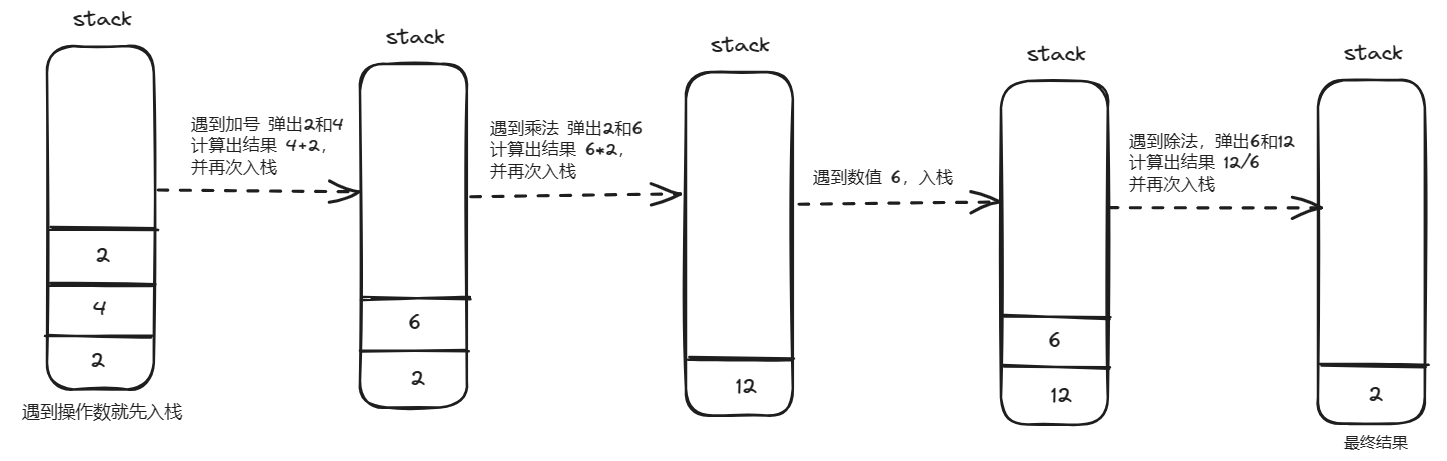
核心代码:
const isNumber = (char: string) => {
    const charCode = char.charCodeAt(0);
    return charCode > 47 && charCode < 58;
}

function calcReversePolishNotation(expression: string) {
    const stack: string[] = [];

    /** 遍历表达式 */
    for (let char of expression) {

        /** 是不是数字,是的话就入栈 */
        if (isNumber(char)) {
            stack.push(char);
            continue;
        }

        /** 是操作符的情况就计算结果,然后把结果再入栈 */
        const newVal = `${calc(char)}`;
        /** 把新的值再次压入栈中 */
        stack.push(newVal);
    }

    /** 把最后的计算结果弹出即可 */
    return stack.pop();
}

// test: 2*(4+2)/3
const result = calcReversePolishNotation('242+*3/');
console.log(result);    // 4
上面代码中,计算 newVal 的主要的流程是:弹出两个栈顶成员,根据操作符做相应运算。代码如下:
const calcMap = {
    '+': (num1: number, num2: number) => num1 + num2,
    '-': (num1: number, num2: number) => num1 - num2,
    '*': (num1: number, num2: number) => num1 * num2,
    '/': (num1: number, num2: number) => num1 / num2,
} as const;

const calc = (operator: string): number => {
    // 出栈
    const num1 = stack.pop();
    const num2 = stack.pop();

    if (typeof num1 !== 'number' || typeof num2 !== 'number') {
        throw new Error('Wrong expression');
    }

    /** 看操作符是不是符合要求的 */
    if (operator in calcMap) {
        return calcMap[operator](Number(num2), Number(num1));
    }

    throw new Error('Unknown expression');
}
中缀表达式转后缀表达式
我们要设计一个计算器程序,用户输入的是更符合人类逻辑思维的中缀表达式,那如何把一个中缀表达式转成后缀表达式呢?
思路
- 初始化两个栈,
operatorStack用于存储运算符,calcResultStack用于存储中间运算结果; - 从左至右扫描中缀表达式;
- 遇到操作数时,将其压入
calcResultStack; - 遇到运算符时,比较它与
operatorStack栈顶运算符的优先级:- 如果
operatorStack为空,或者栈顶运算符为左括号,则直接将它入栈; - 否则,若优先级比栈顶的运算符高,也将其压入
operatorStack; - 否则,将
operatorStack栈顶的运算符弹出并压入calcResultStack中,再把当前的运算符压入到operatorStack中;
- 如果
- 遇到括号时:
- 如果是左括号,则直接压入
operatorStack; - 如果是右括号,则依次弹出
operatorStack栈顶的运算符,并压入calcResultStack,直到遇到左括号为止,此时将这一对括号丢弃;
- 如果是左括号,则直接压入
- 重复步骤 2~5,直到表达式遍历完成,最后把
operatorStack中还剩余的操作符都放入calcResultStack中;
以中缀表达式 6+((2-5)*4)/3 为例(后面以变量exp替代),说明一下步骤。
- 首先第一步,从左往右遍历表达式,遍历到第一个右括号之前都是入栈的操作。
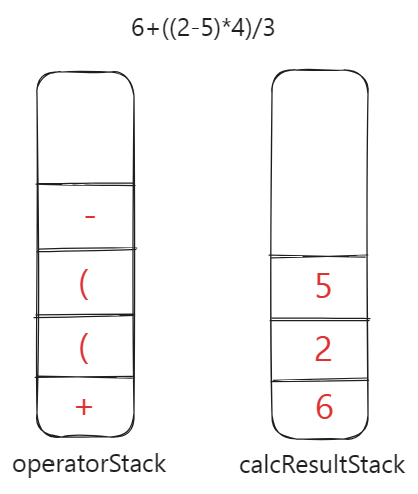
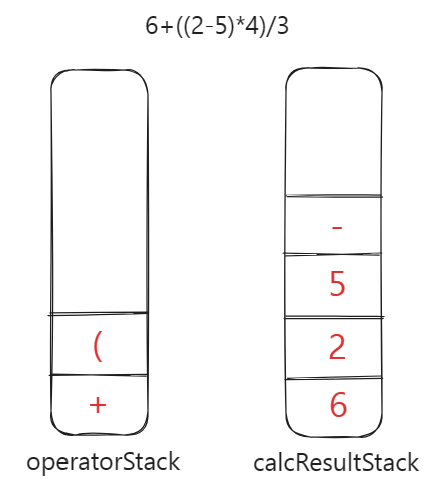
- 遇到第一个右括号,则依次弹出 operatorStack 栈顶的运算符,并压入 calcResultStack 中,直到遇到第一个左括号未知,并把这个左括号从栈中弹出丢弃。
- 接下来还是继续遍历,依次入栈。
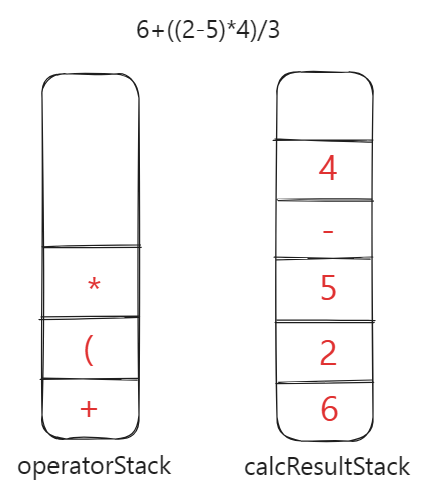
- 遇到第二个右括号,重复上面的步骤二。
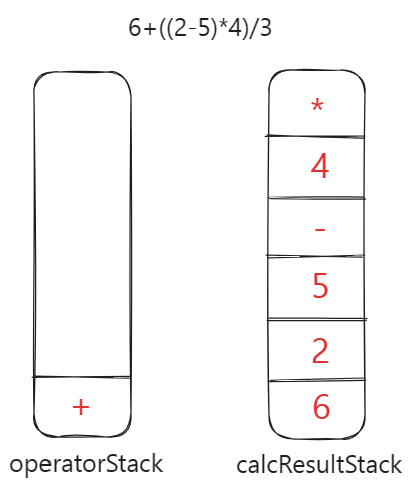
- 遇到
/运算符,它与operatorStack中的栈顶运算符比较,发现优先级比+高,则把/压入operatorStack。然后数字3压入到calcResultStack中。
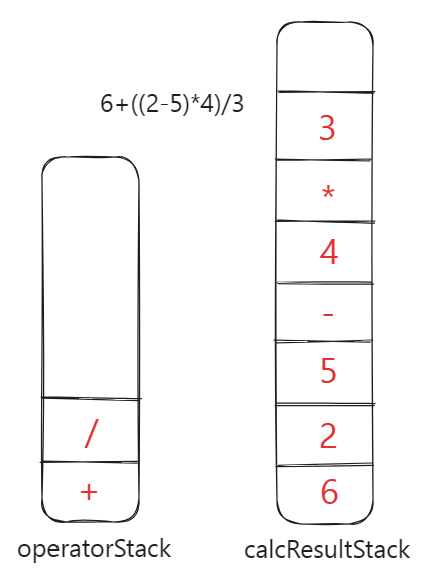
- 表达式扫描完成,把
operatorStack中剩余的操作符压入calcResultStack。
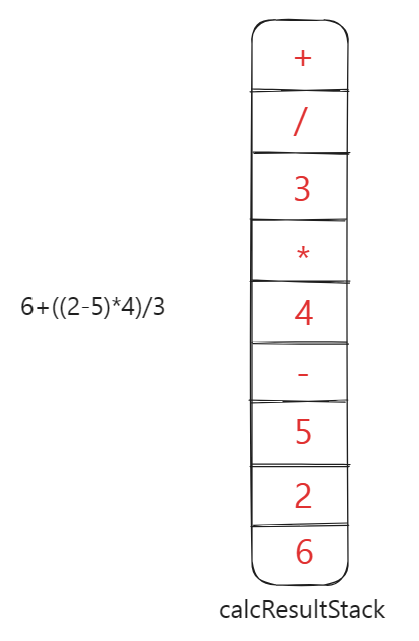
- 从栈底遍历,得到最终的后缀表达式:
625-4*3/+。
实现
首先是一些工具函数,主要包括:
- 存放运算符和中间计算结果的栈;
- 计算函数,用于计算中间值;
- 操作符优先级,用
map表示; - 判断字符是不是运算符、数字、括号、小数点等;
- 判断栈顶元素与新传入的操作符谁的优先级高;
- 判断栈顶元素是不是左括号,扫描表达式遇到右括号时会用到;
- 更新栈顶元素,主要是处理操作数时小数或者多于1位的数字;
class Calculator {
    /**
     * 用于存储运算符(+、-、*、/ 等)
     */
    private operatorStack: string[] = [];

    /**
     * 用于存储计算时的中间结果
     */
    private calcResultStack: (number | string)[] = [];

    /** 空格 */
    private spaceReg = /\s+/;

    /**
     * 运算符和优先级,数值越大,优先级越高
     */
    private operator = new Map([
        ['+', 1],
        ['-', 1],
        ['*', 2],
        ['/', 2],
    ]);

    /**
     * 计算函数
     */
    public calcFn = {
        '+': (num1: number, num2: number) => num1 + num2,
        '-': (num1: number, num2: number) => num1 - num2,
        '*': (num1: number, num2: number) => num1 * num2,
        '/': (num1: number, num2: number) => num1 / num2,
    } as const;

    /**
     * 判断传入的字符是不是数字
     *
     * @param char string
     * @returns boolean
     */
    public isNumber(char: string) {
        const charCode = char.charCodeAt(0);
        return charCode > 47 && charCode < 58;
    }

    /**
     * 判断字符是不是运算符
     */
    public isOperator(char: string) {
        return this.operator.has(char);
    }

    /**
     * 判断字符是不是小数点
     */
    public isPoint(char: string) {
        return char === '.';
    }

    /**
     * 判断是不是左括号
     */
    public isLeftBracket(char: string) {
        return char === '(';
    }

    /**
     * 判断是不是右括号
     */
    public isRightBracket(char: string) {
        return char === ')';
    }

    /**
     * 判断是不是空栈
     */
    public isEmptyStack(stack: string[]) {
        return stack.length <= 0;
    }

    /**
     * 获取栈顶元素
     */
    public getStackTopItem(stack: string[]) {
        return stack[stack.length - 1];
    }

    /** 栈顶元素是不是左括号 */
    public stackTopIsLeftBracket(stack: string[]) {
        var item = this.getStackTopItem(stack);
        return this.isLeftBracket(item);
    }

    /**
     * 判断传入的 operator 是不是比 stack 顶部优先级高
     *
     * @param stack 操作符栈
     * @param operator 操作符
     * @returns boolean
     */
    public isHigherPriority(stack: string[], operator: string) {
        var top = this.getStackTopItem(stack);
        return this.getPriority(top) < this.getPriority(operator);
    }

    /**
     * 更新数值栈的栈顶
     * 比如遇到小数点,需要把之前的数字拼接上小数点
     *
     * @param stack 更新数值栈顶
     * @param operator string
     */
    private updateStackTop(stack: (string | number)[], operator: string) {
        let top = stack.pop() ?? "";
        top += operator;
        stack.push(top);
    }

    /**
     * 获取运算符优先级
     *
     * @param operator 运算符
     * @returns number
     */
    public getPriority(operator: string) {
        return this.operator.get(operator) || -1;
    }

    /**
     * 计算
     */
    private getCalcRes(stack: number[], operator: string) {
        const top = stack.pop();
        const second = stack.pop();
        return this.getResult(second, top, operator);
    }

    /**
     * 计算结果
     */
    public getResult(num1: number, num2: number, operator: string): number {
        if (operator in this.calcFn) {
            return this.calcFn[operator](num1, num2);
        }

        this.throwErr(`Wrong expression', ${num1} ${operator} ${num2}`);
    }

    /** 异常 */
    private throwErr(error: any = 'Wrong expression'): never {
        throw new Error(error);
    }
}
转换函数
转换函数内部会遍历中缀表达式,遇到一个字符就需要判断是操作符还是数字或者别的类型,然后做相应的处理。
public transform(expression: string): (string | number)[] {
    let prevVal = '';   // 记录前一个字符
    const { operatorStack, calcResultStack } = this;

    for (let item of expression) {
        // 当是空格时,则忽略
        if (this.spaceReg.test(item)) continue;

        // 是数字
        if (this.isNumber(item)) {
            // TODO...
        }

        // 是小数点
        else if (this.isPoint(item)) {
            // TODO...
        }

        // 是操作符
        else if (this.isOperator(item)) {
            // TODO...
        }


        // 是左括号,直接 push
        else if (this.isLeftBracket(item)) {
            operatorStack.push(item);
        }

        // 是右括号
        else if (this.isRightBracket(item)) {
            // TODO...
        }

        // 否则认为表达式不正确
        else {
            return this.throwErr();
        }

        // 更新前一个值
        prevVal = item;
    }

    // 最后把剩下的操作符移入 calcResultStack 中
    while(operatorStack.length) {
        calcResultStack.push(operatorStack.pop());
    }

    return calcResultStack;
}
上面代码中除了左括号和空格时好处理,其他都需要额外的边界判断,下面一一分析。
首先是数字时,代码如下:
// 是数字
if (this.isNumber(item)) {
    // 如果当前是数字,看看上一次的输入是不是也是数字或者小数点,
    // 是的话就拼接,否则就直接 push
    prevVal && (this.isNumber(prevVal) || this.isPoint(prevVal)) ?
        this.updateStackTop(calcResultStack, item) :
        calcResultStack.push(Number(item));
}
然后是小数点:
// 是小数点
else if (this.isPoint(item)) {
    // 如果当前是小数点,prevVal 是数字,那么就检查栈顶元素是不是已经有了小数点
    const top = this.getStackTopItem(calcResultStack);
    // 栈顶和当前都是小数点,认为表达式不正确
    if (top === '.')    return this.throwErr();
    // 没有小数点就更新栈顶元素(字符拼接)
    this.updateStackTop(calcResultStack, item);
}
然后是操作符:
// 是操作符
else if (this.isOperator(item)) {
    // 当前和上一次都是操作符,则认为表达式不正确
    if (prevVal && this.isOperator(prevVal)) {
        return this.throwErr();
    }

    while (true) {
        // 如果操作符栈是空栈,或者栈顶是左括号,则直接 push
        if (this.isEmptyStack(operatorStack) || this.stackTopIsLeftBracket(operatorStack)) {
            operatorStack.push(item);
            break;
        }

        // 如果栈顶运算符比当前的运算符优先级低,则直接 push
        if (this.isHigherPriority(operatorStack, item)) {
            operatorStack.push(item);
            break;
        }

        // 否则,把栈顶元素弹出,然后加入到 calcResultStack
        // 循环直到 operatorStack 变成空栈或者顶运算符比 item 优先级高
        const top = operatorStack.pop();
        calcResultStack.push(top);
    }
}
最后是右括号:
// 是右括号,需要弹出 operatorStack 中的操作符
// 直到遇到第一个左括号结束
else if (this.isRightBracket(item)) {
    let hasLeftBracket = false;

    while (operatorStack.length) {
        // 弹出操作符栈栈顶元素
        const op = operatorStack.pop();
        // 判断是不是左括号,是的话跳出循环
        if (this.isLeftBracket(op)) {
            hasLeftBracket = true;
            break;
        }
        // 不是左括号,则把运算符 push 到 calcResultStack
        calcResultStack.push(op);
    }

    // 到最后都没有找到左括号,说明表达式有问题
    if (!hasLeftBracket) return this.throwErr();
}
transform 函数最后返回的是一个 Array<number|string>,内部可能是操作符、小数数字或者整数。
计算函数
转换成逆波兰式后,接下来就是最终的计算了,代码与上面 逆波兰式求值过程 章节基本一样,代码如下:
public calc(expression: (string | number)[]) {
    const stack: number[] = [];

    for (let item of expression) {
        // 是数字,并且不是 NaN
        if (typeof item === 'number' && item === item) {
            stack.push(item);
        }

        // 是字符串类型
        else if (typeof item === 'string') {
            // 是空白字符,则忽略
            if (this.spaceReg.test(item)) continue;

            const num = Number(item);
            // 是数字字符,直接 push
            if (num === num) {
                stack.push(num);
                continue;
            }

            // 是操作符
            else if (this.isOperator(item)) {
                if (stack.length > 1) {
                    const newVal = this.getCalcRes(stack, item);
                    stack.push(newVal);
                }

                // 如果 stack 中没有两个数值,表明这个表达式不合法
                else return this.throwErr();
            }
        } else {
            return this.throwErr();
        }
    }

    // 返回最终结果
    return stack[0];
}
到此,一个简单的计算器就实现了,简单测试一把:
// test-1: 支持小数
let exp = '1.8+((2-3.5)*4)-5.8';
let calcu = new Calculator();
let rs = calcu.transform(exp);
console.log('rs-1 ===>', rs);
console.log('result-1 ===>', calcu.calc(rs));    // -10

// test-2
exp = '6*((13-5)/4)+3';
calcu = new Calculator();
rs = calcu.transform(exp);

console.log('rs-2 ===>', rs);
console.log('result-2 ===>', calcu.calc(rs));    // 15
前缀表达式
除了中缀表达式和后缀表达式外,还有前缀表达式,前缀表达式的操作符通常都在数字的前面。
前缀表达式求值过程如下:
- 从右至左遍历前缀表达式;
- 遇到数字压入堆栈;
- 遇到运算符时,弹出栈顶两个数,用运算符做相应的运算(栈顶元素和次顶元素),并将结果入栈;
- 重复上面操作过程,直到遍历完表达式;
比如 (3+4)*5-6 对应的前缀表达式为 -*+3456,求值过程就不演示了,大家可以按照上面步骤演算一下。